
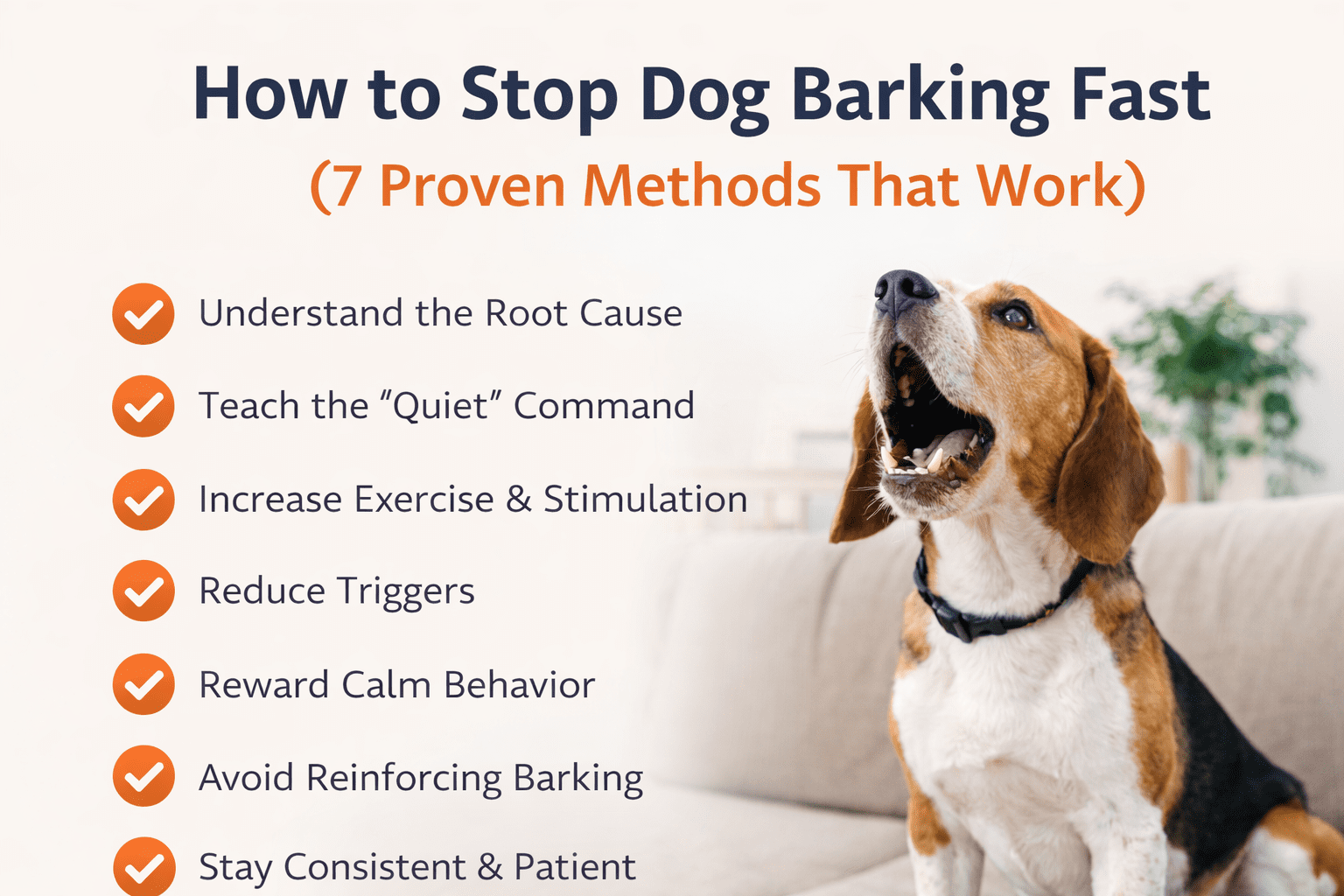
How to Train Your Dog to Stop Barking (7 Proven Methods)
If you are trying to stop dog barking, you are not alone. Excessive barking is one of the most common problems dog owners face.
Excessive barking is one of the most common problems dog owners face. While barking is a natural way for dogs to communicate, constant or unnecessary barking can quickly become stressful—not only for you but also for your neighbors.
The goal is not to stop barking completely. Instead, you should focus on controlling when and why your dog barks. With the right approach, you can reduce excessive barking and create a calmer, more peaceful environment at home.
1. Understand the Root Cause of Barking
Dogs always bark for a reason. It may be attention-seeking, boredom, anxiety, fear, or reacting to something in their environment.
For example, if your dog barks when you leave the house, it could be separation anxiety. If they bark at every noise, they may be reacting to triggers around them.
Understanding the cause is the most important step. Without it, you are only treating the symptom, not the problem.
2. Avoid Reinforcing Barking Behavior
Many owners unintentionally reward barking. When your dog barks and you respond immediately—by talking, yelling, or even looking at them—you are giving attention.
From your dog’s perspective, barking worked.
Instead, ignore barking when it is clearly attention-seeking. Only interact with your dog when they are calm and quiet. This teaches them that silence gets rewarded—not noise.
3. Teach the “Quiet” Command
Training your dog to understand a command like “quiet” can be very effective.
Let your dog bark, then calmly say “quiet.” As soon as your dog stops barking, reward them immediately with a treat or praise.
Repeat this process consistently. Over time, your dog will associate the word “quiet” with stopping barking.
4. Increase Physical and Mental Activity
A bored dog is a noisy dog.
Dogs that do not get enough exercise often release their energy through barking. Daily walks, playtime, and mental stimulation can make a huge difference.
Try using puzzle toys, training games, or short training sessions to keep your dog engaged. A tired dog is much more relaxed and less likely to bark excessively.
5. Remove or Reduce Triggers
Many dogs bark because of external triggers such as people walking by, other animals, or loud sounds.
If your dog reacts strongly to these triggers, try to reduce their exposure. Closing curtains, moving their resting area, or using background noise can help.
Managing the environment is often one of the easiest ways to reduce barking.
6. Reward Calm Behavior
Positive reinforcement is one of the most effective training methods.
Whenever your dog stays quiet in a situation where they would normally bark, reward them. This helps your dog understand that calm behavior leads to positive outcomes.
Over time, your dog will naturally choose to remain calm instead of barking.
7. Be Consistent and Patient
Training takes time. There is no instant solution to stop barking.
Consistency is the key. If you sometimes allow barking and sometimes try to stop it, your dog will become confused and the behavior will continue.
Make sure everyone in your household follows the same rules and uses the same commands. Consistency builds habits, and habits shape behavior.
Common Mistakes Dog Owners Make
One of the biggest mistakes dog owners make is using punishment or yelling to stop barking. This often makes the situation worse.
Dogs may think you are joining in the barking or may become anxious, which increases the behavior.
Another mistake is expecting immediate results. Training takes time, and progress happens gradually.
When to Seek Professional Help
In some cases, excessive barking may be linked to deeper behavioral issues such as anxiety or stress.
If your dog barks constantly, shows signs of distress, or becomes destructive, it may be time to consult a professional dog trainer.
Early intervention can prevent long-term problems.
Final Thoughts
Barking is a natural behavior, but excessive barking can be controlled with the right approach.
By understanding your dog, using consistent training methods, and rewarding calm behavior, you can significantly reduce unwanted barking.
Every dog is different, but with patience and effort, you will see real progress and create a more peaceful environment for both you and your pet.
Extra Tip: Create a Calm Environment
Creating a calm and structured environment can greatly reduce your dog’s barking. Dogs feel more secure when they have a routine and a predictable daily schedule.
Make sure your dog has a comfortable resting area, regular feeding times, and enough mental stimulation throughout the day. Reducing stress in your dog’s environment naturally leads to less barking and better behavior overall.